
Today, October 24th, is the International Day of Climate Action, a reminder that our choices and actions matter on a global scale when it comes to the fate of our planet. Every action we take can contribute to a healthier, greener future for generations to come, from our work and education to our personal lives.
At Coventry University, we have a diverse mix of international students, many hailing from regions highly vulnerable to the impacts of climate change. One of our student ambassadors, Edward, is from Delta State in Nigeria. We asked him about how climate change was affecting his part of the world.
What are the issues facing your home country?
Climate change is a global phenomenon, but its impacts are local and uneven.[i] For instance, as countries in the global south and say farmers and fishermen are more susceptible to the whiplash of climate change than most. Oil spills and long-term exposure to flaring of natural gas (byproducts of oil exploration) has a particularly worrisome effect on climate of Nigeria.[ii]
Nigeria is the most populous country in Africa and arguably the largest economy on the continent.[iii] It is also a major player in global oil production, thanks to its extensive oil and gas reserves located predominately in the Niger Delta. This region is blessed with the largest freshwater swamp in Africa and the third largest mangrove forest in the world with unparalleled biodiversity.[iv] Designated by the World Wildlife Fund as one of 14 biomes in the world that require protection,[v] the Niger Delta is a region shaped by the many tributaries of the lower River Niger, which flows into the Atlantic Ocean through various estuaries. It is home to a rich biodiverse and a densely populated human community.
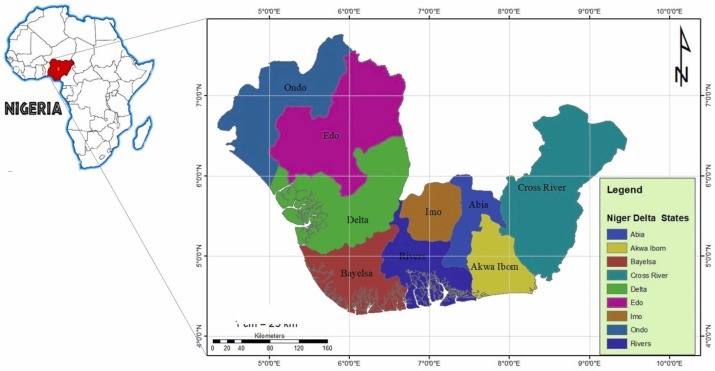
The region consists of several states, as shown in Figure 1 above, covering approximately 7.5% of Nigeria’s land area. Home to over 31 million people from over 40 ethnic groups, speaking 250 different languages, and spread across 185 Local Government Areas (LGAs). Around 1,500 towns and cities.[vi]
When crude oil was discovered in the creeks of the Niger Delta in 1956,[ii] no one could have foreseen that this singular discovery would be the undoing of my home country.[iii] Overnight, she became the unwitting supplier of crude to a world addicted to non-renewable energy. The insatiable global demand for fossil fuels is her bankruptcy.[iv] The curse of crude oil unleashed the deleterious effects of climate change in Nigeria and heralded the beginning of the end of biodiversity in the once beautiful Niger Delta and today. According to the Organization of the Petroleum Exporting Countries (OPEC), Nigeria has the 8th largest proven crude oil reserve in the world,[v] and alone produces 1.57 million barrels of oil each day.[vi]
What is being done to mitigate climate change in these areas?
In 2006, The Federal Government of Nigeria and international organization such as the United Nations Environmental Programme (UNEP) finally took action to arrest the environmental disaster of the Niger Delta, by addressing the issues bedevilling the region. However, these efforts have left much to be desired.[i] A case in point was the UNEP independent scientific assessment of the Niger Delta region carried out in 2011, were over 200 locations where visited, 5000 medical records of the indigenous people of the Niger Delta reviewed and over 23,000 community town hall meeting attended. The UNDP admitted the extent of the problem and enormity of the solution, which must require “…the world’s most wide-ranging and log-term oil clean-up exercise ever undertaken is required, if contaminated drinking water, land, creeks and important ecosystems such as mangroves are to be brought back to full productive health.” The 2018 Hydrocarbon Pollution Remediation Project (HYPREP) project is a direct consequence of the UNEP environmental impact assessment. The HYPREP project is set up to clean up and restore the environment of the Niger Delta, a task with a 30-year time frame[ii] and a US$ 1 billion price tag for the first five years alone.[iii]
What is predicted to happen in the future if current levels of climate change continue?
The Niger Delta Mangrove ecosystem is one of Nigeria’s most ecologically significant and diverse environments. It is home to a variety of species, including Avicennia sp., Rhizophora sp., and Laguncularia racemosa. These species play vital roles, providing essential ecological services such as carbon storage, nutrient cycling, and shoreline protection, alongside cultural and aesthetic benefits. The global decline of mangroves, estimated at 30–50% over the past 50 years, could significantly undermine the ecological value of Nigeria’s mangrove wetlands. In recent decades, threats to this area have greatly increased due to oil and gas exploration.[iv]
What actions are you taking to reduce your own carbon footprint?
I firmly believe that legislation and awareness are the most effective method to protect the environment. These tools are essential in the fight against climate change.[v] As a lawyer, before moving to the UK, I formally called on Parliament to address these issues, calling for action over the irreplaceable loss of biodiversity in the Niger Delta. I advocated the cause for climate justice in the Niger Delta and for those, whose voices often go unheard, those who call this desecrated and abused piece of ground, otherwise known as the Niger Delta their home.
This approach may appear slow, incremental and sometimes frustrating, but I believe that the burden of knowledge is the responsibility to speak truth to power, and perhaps, one day power will listen, and a change will come. However, not much has changed and the people caught in the web of the deleterious reality of climate change are between a rock and a hard place. With water everywhere, but none to drink.
References
- https://www.sciencedirect.com/science/article/pii/S240588072200022X page 2.
- https://www.intechopen.com/chapters/87912
- https://www.bloomberg.com/news/articles/2024-04-18/nigeria-s-economy-once-africa-s-biggest-slips-to-fourth-place
- https://link.springer.com/chapter/10.1007/978-3-031-17972-3_7
- https://www.worldwildlife.org/publications/terrestrial-ecoregions-of-the-world
- https://www.sciencedirect.com/science/article/pii/S2352485524002019
- https://www.unep.org/topics/disasters-and-conflicts/country-presence/nigeria/ogonilands-oil-history
- https://www.theguardian.com/global-development/2019/dec/06/this-place-used-to-be-green-the-brutal-impact-of-oil-in-the-niger-delta
- https://www.sciencedirect.com/science/article/pii/B9780128093993000057
- https://www.opec.org/opec_web/en/data_graphs/330.htm
- https://www.reuters.com/world/africa/nigeria-pumping-167-million-bpd-oil-condensates-per-day-nnpc-head-2023-09-01/
